TRL Levels 1–9 Explained

Technology Readiness Levels (TRLs) measure how mature a technology is on a scale from 1 to 9: from observing basic principles to proving a system in operation. Technology readiness does not automatically mean a product is ready for manufacturing or commercial launch.
You have an idea. Perhaps you have some sketches. Maybe the electronics already work on a breadboard. Or perhaps you have a prototype held together with 3D-printed parts, tape and optimism. Then someone asks:
“What TRL are you at?”
TRLs are widely used in R&D, medical technology, aerospace, energy and robotics. You will also encounter them when applying for grants or speaking with investors, who want to know what you have tested and what still needs to be proven.

Each level describes the evidence available, from early experiments to operation in the intended setting.
TRL 1 – Basic principles observed: the underlying scientific or technological principle exists.
TRL 2 – Technology concept formulated: you have identified how that principle could become a useful technology.
TRL 3 – Experimental proof of concept: experiments demonstrate that the important technical principle actually works.
TRL 4 – Technology validated in the lab: the main technical components have been combined and tested under controlled conditions.
TRL 5 – Technology validated in a relevant environment: the technology is tested under conditions that increasingly resemble actual use.
TRL 6 – Technology demonstrated in a relevant environment: a representative prototype demonstrates that the technology can work in its intended environment.
TRL 7 – Prototype demonstrated in an operational environment: a near-final system is tested under realistic operating conditions.
TRL 8 – System complete and qualified: the system is essentially finished and has passed the necessary verification or qualification.
TRL 9 – System proven in operation: the technology is successfully being used in the real world.
Further reading: ESA’s explanation of Technology Readiness Levels.

TRLs help you decide what to test next. A sensor that works in the laboratory may be around TRL 4, but its performance in the intended environment still needs to be checked. For a hardware developer, that test sits alongside other practical questions: can the sensor fit inside the housing, can users operate it, and can it be produced for €80 rather than €800? These questions affect the development plan even though a TRL assessment does not answer all of them.

Start with the evidence you are missing. The next test depends on how far the technology has progressed:
At TRL 2–3, that may mean experiments demonstrating the fundamental principle.
At TRL 3–4, you start integrating technical components into working prototypes.
At TRL 4–5, you test them under increasingly realistic conditions.
Around TRL 5–6, the prototype needs to become representative of the intended product. Industrial design, electronics, engineering, ergonomics, materials and manufacturing considerations start coming together.
At TRL 7–8, attention increasingly shifts towards verification, certification, tooling, suppliers, production and repeatability.
Before building a prototype, write down the question it needs to answer and how you will judge the result. That helps you decide what to build and which details can wait.

The CosyLift adjustable bed system for Octo Actuators is a good example. Octo approached ManGo with a rough but functional prototype. It had already shown that the mechanism could work, so we could focus on turning it into a consumer product. The work covered product architecture, industrial design and engineering towards manufacturing. Around the middle TRLs, this is a common challenge: making a working mechanism reliable and affordable enough for everyday use.

From TRL 5 onwards, the words relevant environment become increasingly important. Testing something on an engineer's desk is not necessarily the same as testing it where customers will use it. Take the IMPALA patient-monitoring system developed with GOAL3. It was designed to provide hospital-grade monitoring in resource-limited healthcare environments.
A test in a Dutch office would miss some of the conditions the monitor encounters in African hospitals, including heat, humidity and unreliable power. During development, ManGo used thermal testing and airflow simulations to check cooling, while a protective sleeve helped the device withstand knocks and falls.
Field use also revealed an unexpected problem: young cockroaches entered the monitor, fed on one another and grew too large to escape. Their droppings contaminated the electronics. That is the sort of problem a design review can easily miss.

TRLs become particularly useful when looking for funding because many innovation programmes are designed around moving technologies from one maturity level to another. Very roughly:
TRL 1–3: research and early feasibility
Research grants, university programmes and early deep-tech funding are most relevant here. For conventional hardware investors this can still be rather early because fundamental technical questions remain unanswered.
TRL 3–5: proof of concept and validation
This is an interesting area for innovation subsidies, R&D programmes and specialised seed investors. You have demonstrated something tangible, but substantial development risk remains.
TRL 5–6: demonstration and fundraising
A representative working prototype can make conversations with investors, strategic partners and funding bodies considerably easier. You can now demonstrate rather than merely describe.
TRL 6–8: industrialisation and commercialisation
Funding increasingly shifts towards certification, manufacturing, demonstration and market introduction. European programmes such as the EIC Accelerator specifically target innovations around these stages.
TRL 9: growth
Once the technology is proven in operation, investment discussions tend to move towards customers, revenue, margins, production capacity and scaling.
The TRL alone will not determine whether you can raise investment.
For many hardware startups, TRL 3–4 can be enough to begin seed conversations, particularly with investors familiar with early technology development. Around TRL 5–6, a representative prototype gives those conversations more substance. Explain what the tests have established, where uncertainty remains and what the proposed investment will let you prove next.

A prototype that looks like a finished product can help with presentations and user testing, but tells you little about technical performance or production costs. Decide which of these you need to learn about before choosing the type of prototype.
At ManGo, an ergonomic prototype might be enough to check dimensions and handling. A functional prototype lets us test a mechanism; a pre-production prototype helps us check manufacturing. Cardboard or a 3D print may answer an early question before you commit to production tooling.
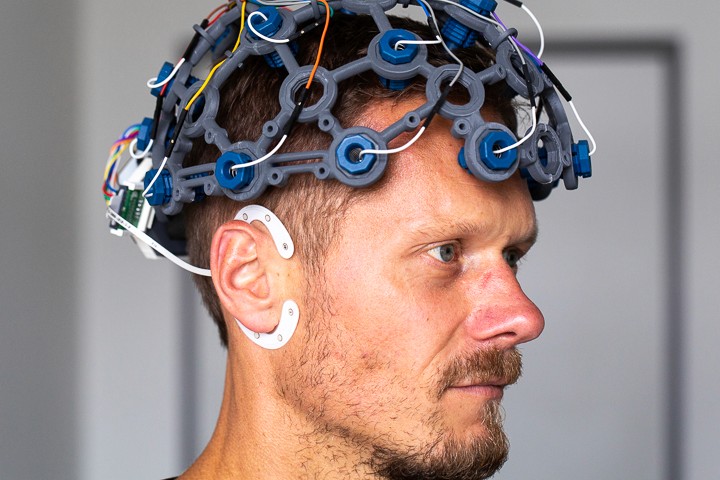
At ManGo Product Design, we help teams decide what their next prototype needs to prove. For an early concept, that may mean building and testing a mechanism. Around TRL 4–6, the work often involves integrating components into a representative product and testing it with users. Later, we help develop the design for manufacturing and verify that it can be produced reliably.

Before putting a TRL in your pitch deck or grant application, ask yourself:
What have we actually demonstrated? Under what conditions? What remains unproven? What evidence would we need to reach the next level?
Not sure what TRL your product is at, or what you need to prove next? ManGo can help assess where you are today and define the practical development steps towards your next milestone.

©2026 ManGo Product Design | Privacy Policy | Terms & conditions | Cookies